Source boundary: Google Photos still labelled these items “Partial upload” at the recorded fetch time. This release uses the complete 1080×1920 copies then available; source hashes and this status are preserved for a later original-file rerun.
Practice update · 16 August 2026
Transition achieved. Repeatability is next.
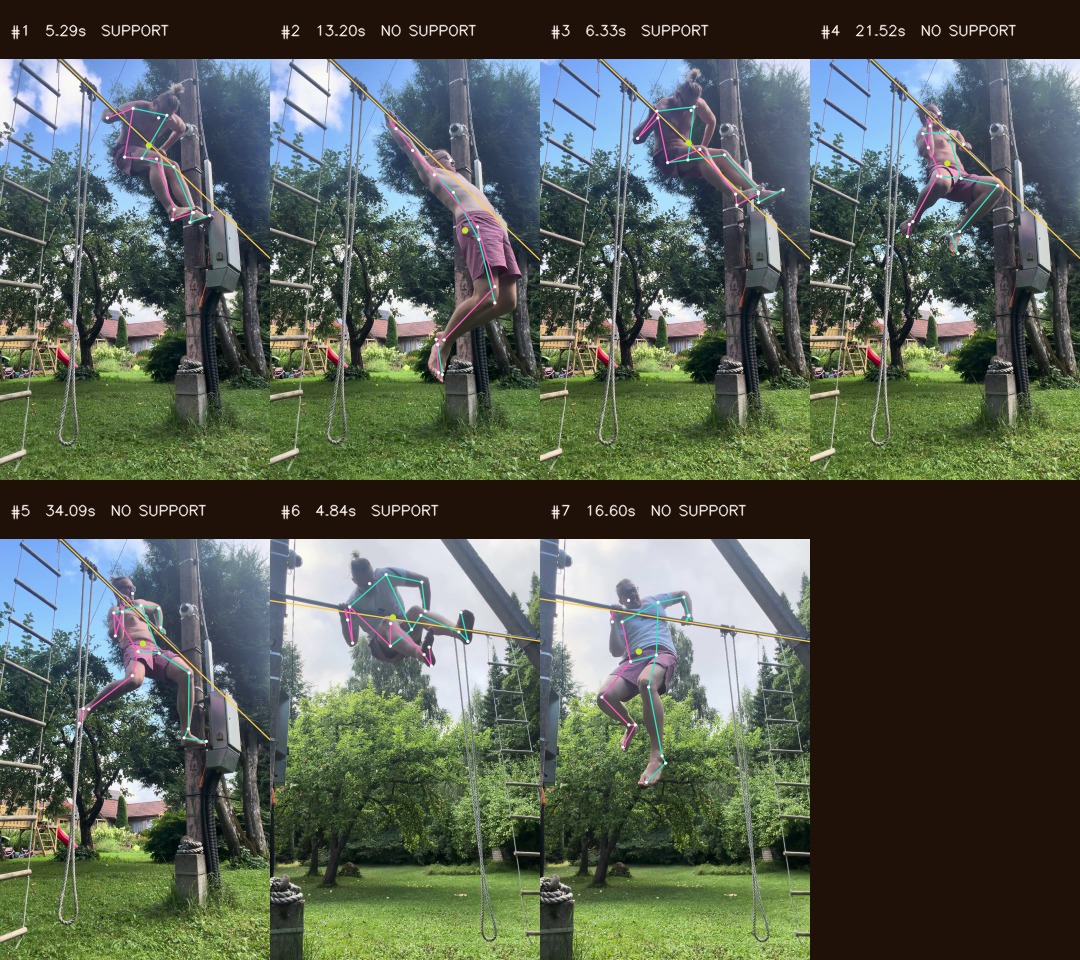
Three fixed-camera clips show seven attempts: the first attempt in every clip reaches stable top support. All four later attempts lose the turnover under continued work. The old question was can the bar be cleared? The current question is can the same projected bar clearance and coordinated turnover be repeated after the first rep?
01 / synchronized evidence
Inspect every clip.
Switch between original and full-frame annotated video. Jump to any reviewed attempt; the telemetry trace and frame readout follow the playhead.
Loading…
Frame telemetry
Text summary for this trace
Select a clip and metric to load its reviewed-window ranges.
Time—
Window—
COM / bar-normal—
Chest / bar-normal—
Mean elbow—
Asymmetry—
02 / diagnosis
What the new footage changes.
The successful first attempts supersede the previous “transition height” bottleneck as an absolute limitation. Height and turnover are now demonstrably available; maintaining them across repeated efforts is not.
Train repeatable singles, not fatigued misses.
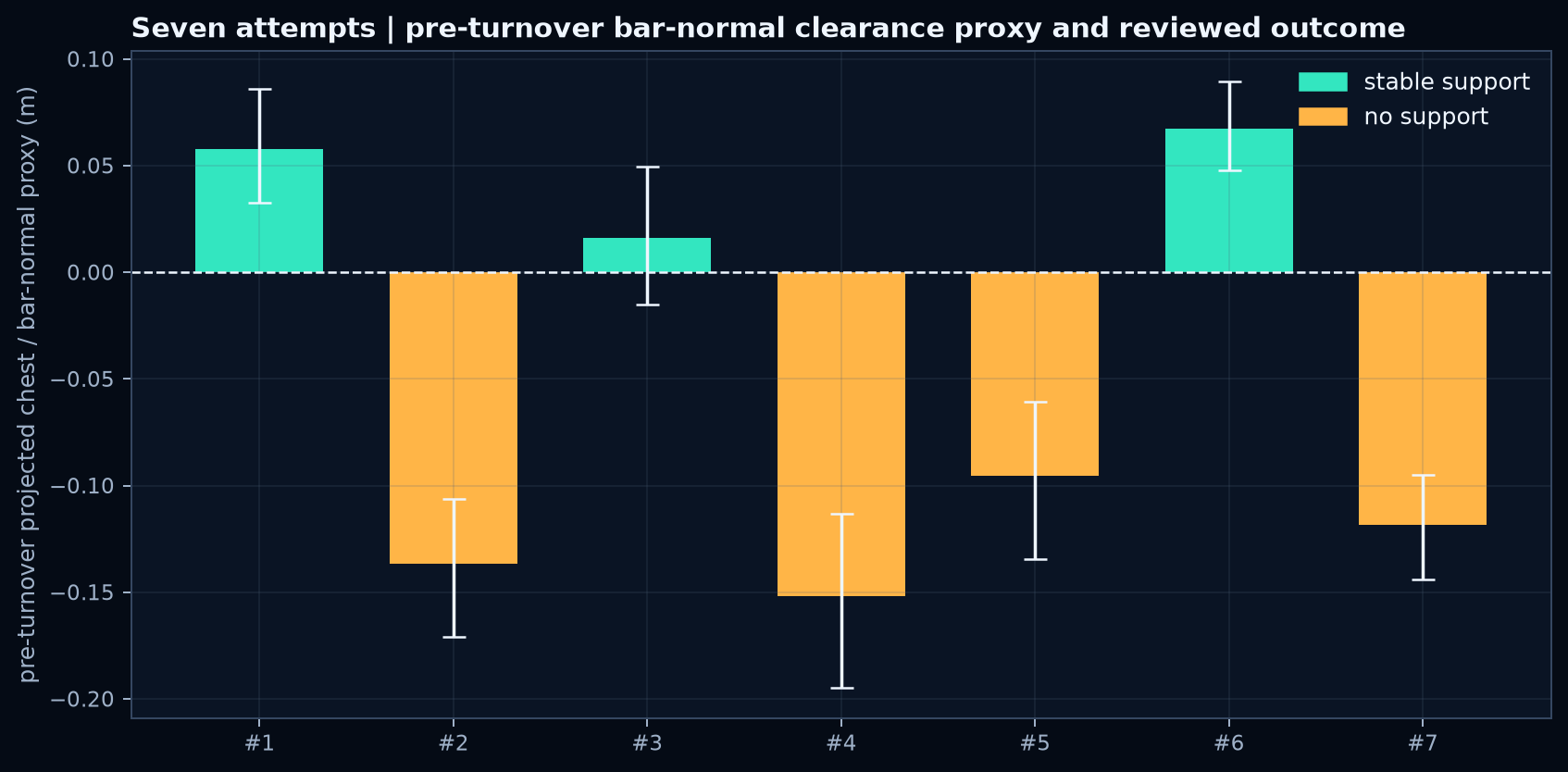
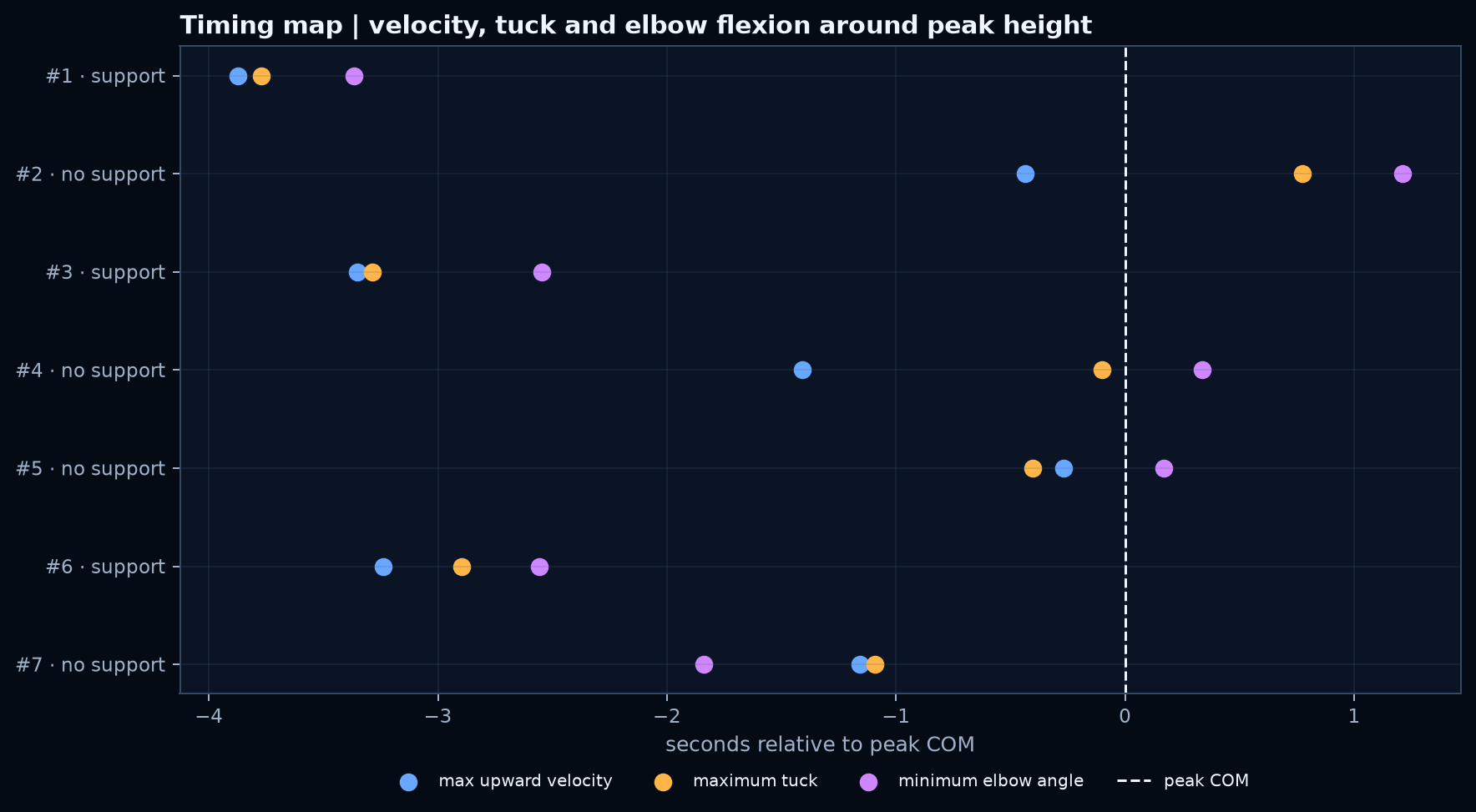
Evidence: attempt one succeeds in all three clips; attempts two and three do not. The pattern is 3/3 fresh-first success versus 0/4 later success. Within-clip 2D projection proxy: later attempts lost 0.11–0.19 m of pre-turnover chest-to-bar-normal clearance versus that clip’s first attempt; the combined uncertainty envelopes did not overlap. The corrected maximum bar-normal rate did not decrease consistently, so this release no longer presents speed loss as the shared failure mechanism.
Action: use 3–5 technically clean singles with 2–3 minutes rest. End the set when the pull no longer places the lower chest at bar height or when one elbow leads the turnover.
Make the turnover bilateral.
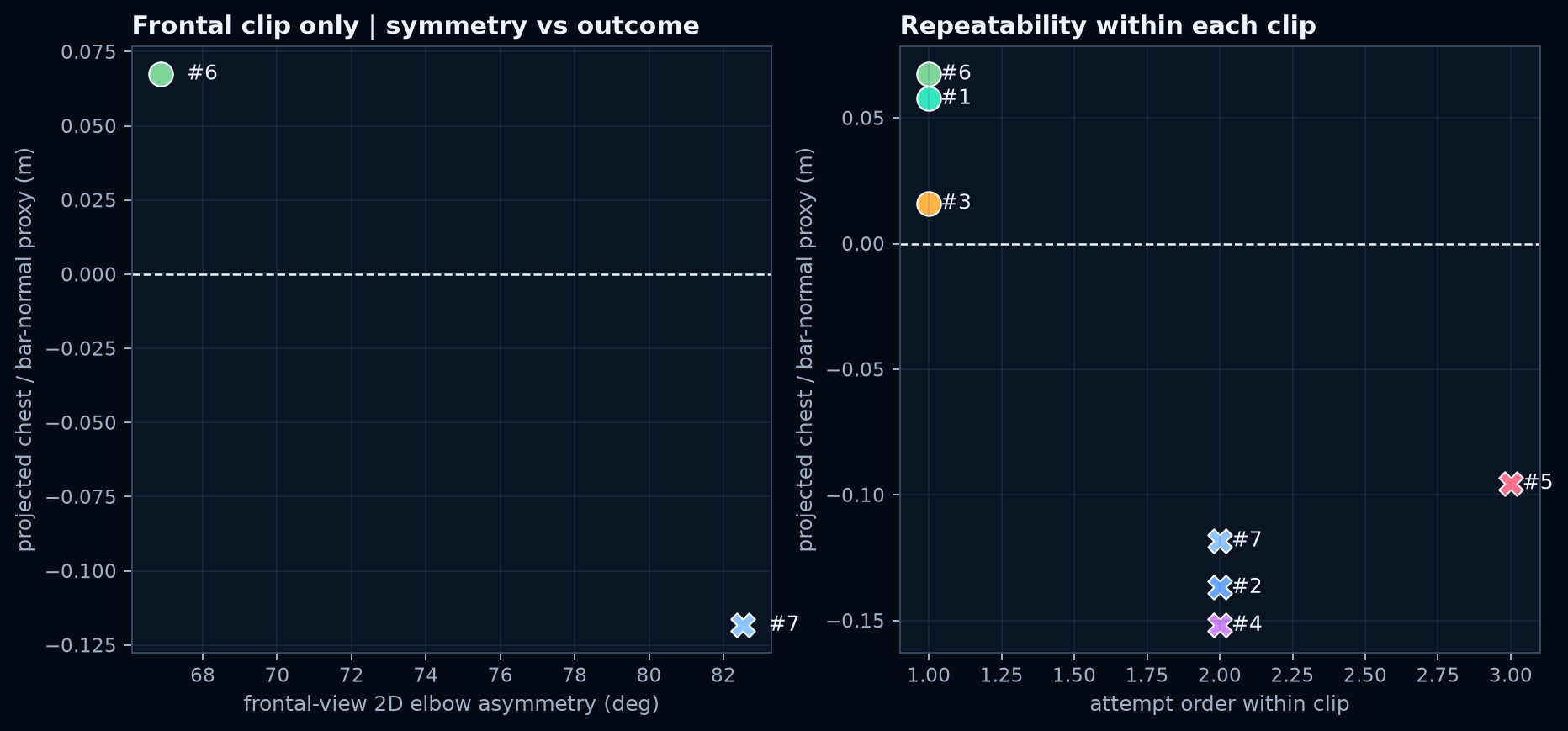
Evidence: reviewed later attempts in clips 2 and 3 show partial one-side-first turnover without stable support; the frontal clip also shows a pronounced leg split during the miss. Frontal-only directional proxy: elbow asymmetry increased from 67° to 83° and tracked ankle spread from 0.53 m to 1.21 m; absolute values remain projection/model-sensitive.
Action: low-bar or band-assisted turnovers: pull to lower sternum, keep both wrists above the same line, then send both elbows back together. Film front-on.
Keep the tuck as a timing tool, then close it sooner.
Evidence: every high attempt uses a compact knee tuck. Tuck alone is not sufficient: it is present in both support and non-support outcomes.
Action: cue “tuck to accelerate, chest over, legs quiet.” In assisted reps, demand a narrower leg path and no late scissor once the chest reaches bar height.
Standardize the setup before judging fatigue.
Evidence: several later attempts begin from a continuing hang, whereas successful first efforts follow a fresh jump/grip and initial swing. Setup momentum and fatigue are confounded.
Action: next session: step down between attempts, rest on a timer, use the same grip marks and one prescribed swing. This separates repeatability from setup differences.
03 / attempt ledger
Seven reviewed windows.
Outcome is assigned by visual evidence of a stable support position—not by a model threshold. Successful-attempt clearance is capped at the last clearly pre-turnover frame, avoiding comparison of supported top-position geometry with failed hanging-side peaks. Chest/bar and rate values are stature-scaled, signed image-normal projection proxies—not laboratory vertical height or velocity. Elbow asymmetry is reported only for the frontal clip; side-oblique projection makes that number unsafe to compare.
Swipe or use Shift + mouse wheel to scroll horizontally for all metrics.
| Set | Clip/local | Outcome | Window | Pre-turnover chest/bar-normal | Max bar-normal rate | Min elbow | Frontal 2D asym. |
|---|---|---|---|---|---|---|---|
| #1 | IMG_6710 / 1 | stable support | 1.45–7.51s | +0.06 m | 1.00 m/s | 46° | view-limited |
| #2 | IMG_6710 / 2 | no support | 11.41–15.39s | -0.14 m | 1.34 m/s | 63° | view-limited |
| #3 | IMG_6711 / 1 | stable support | 2.21–7.91s | +0.02 m | 0.96 m/s | 47° | view-limited |
| #4 | IMG_6711 / 2 | no support | 18.30–22.79s | -0.15 m | 1.18 m/s | 70° | view-limited |
| #5 | IMG_6711 / 3 | no support | 31.41–34.96s | -0.10 m | 0.91 m/s | 62° | view-limited |
| #6 | IMG_6712 / 1 | stable support | 1.30–6.78s | +0.07 m | 1.57 m/s | 37° | 67° |
| #7 | IMG_6712 / 2 | no support | 13.81–18.31s | -0.12 m | 1.29 m/s | 34° | 83° |
04 / next session
Make the next comparison cleaner.
The shortest route to a useful answer is a controlled repeatability test—not more uncontrolled attempts.
- Use the frontal camera position from clip 3, fixed on a tripod; keep the full bar, hands and feet in frame.
- Mark both hand positions on the bar and the take-off point on the ground. Use one prescribed swing per attempt.
- Record one fully rested single, then three singles with exactly 2:30 rest. Step down after each attempt.
- If available, record 60–120 fps and include a known-length object in the athlete’s plane. State body mass that day only if force proxies are wanted.
- Success criterion: both elbows pass together into stable support without a leg split; hold two seconds. Stop after two technical misses.
05 / method boundaries
Deep, but not falsely precise.
Every clip is decoded in full, tracked against its own active grip tube, and cross-checked with a second pose model. Visual outcomes remain the authority for support/turnover classification.
Direct evidence
Original frames, timestamps, top-support outcome, visible swing/tuck/turnover, fixed-camera geometry and source hashes.
Calibrated/model-derived
MediaPipe Heavy at native frame rate; YOLO11m-pose at ~10 Hz; background-feature camera compensation; paired-edge bar tracking; stature-scaled 2D projected distances. Clips 1 and 2 use visually reviewed positive-slope grip-tube anchors, with regression checks against the wrong near-horizontal line. Across reviewed windows, median MediaPipe confidence is 0.80–0.97 and median YOLO/MediaPipe landmark disagreement is 16–23 px. Active-bar residual p95 is 5–14 px across clips.
Limits
One camera cannot recover calibrated out-of-plane motion, true vertical clearance, bar force, joint torque or muscle activation. Absolute cross-view angle and rate comparisons are avoided.
Coaching analysis, not medical advice. Bar-line uncertainty, ±7% apparent-scale sensitivity and smoothing sensitivity are propagated into the published projection-proxy ranges.
06 / provenance
Download the evidence.
The package contains reviewed windows, per-frame telemetry, model/camera/bar methodology, source hashes and reproducibility scripts. Identifiable footage is published with the athlete’s explicit instruction.